



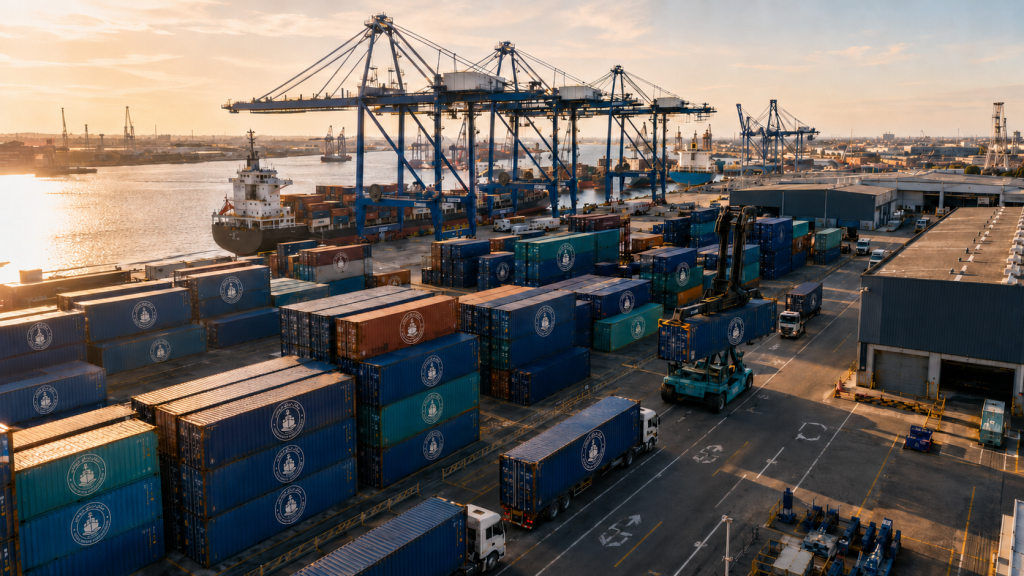
Types of Containers
As we mentioned earlier, containers are among the most widely used and important products in the transportation and movement of goods both domestically and internationally. In this section, we will examine the different types of containers based on their dimensions and applications.
Containers by Size
The dimensions of a container are measured in feet. Containers are available in 10-foot, 20-foot, 30-foot, and 40-foot sizes, with 20-foot and 40-foot containers being the most common.
It should be noted that 45-foot containers are currently used by shipping lines. Containers have various applications and are used for transporting iron ore, limestone, and in maritime transportation.
Classification of Containers by Size
10-Foot Container
20-Foot Container
40-Foot Container
40-Foot High Cube Container
10-Foot Container
A 10-foot container has dimensions of 3 × 2.5 meters with a height of 2.60 meters. It is known as a 3-meter container and is a suitable option for cargo storage.
20-Foot Container
A 20-foot container has dimensions of 6 × 2.5 meters with a height of 2.60 meters and is used for cargo storage and cargo transportation.
40-Foot Container
A 40-foot container has dimensions of 12 × 2.5 meters with a height of 2.60 meters. This container is the most widely used type in the transportation industry compared to other container types.
40-Foot High Cube Container
A High Cube container is available with dimensions of 12 × 2.5 meters and a height of 2.90 meters. The difference between these containers and standard 40-foot containers is their height, which is why they are also known as high containers. This type of container is used for transporting tall cargo.
General Classification of Containers by Application
Dry Container (Normal Container)
Reefer Container
Open Side Container
Open Top Container
Insulated Container
Ventilated Container
Heated Container
Tank Container
Flat Rack Container
Platform Container
Dry Container
These are the most common and widely used containers and are available in 20-foot and 40-foot sizes.
.jpg)
Reefer Container
Since this container is equipped with a refrigeration system, it is suitable for transporting food products and perishable goods.
.jpg)
Open Side Container
One or more large opening doors are located on the side of the container, making loading easier.
.png)
Open Top Container
As the name suggests, this type of container does not have a roof and is used for transporting dry cargo such as sand, gravel, and legumes. A tarpaulin is used to cover the top of the container.
.jpg)
Insulated Container
The structure of this type of container is made of insulating materials to prevent cold from turning into heat or to prevent heat from entering. It is used for transporting medicines, frozen meat, and other similar goods.
.jpg)
Ventilated Container
It is used for transporting cargo that requires proper ventilation to prevent spoilage. Coffee and beans are among the goods transported in these containers.
.jpg)
Heated Container
This container is insulated in its walls and roof and is equipped with a heating unit.
.jpg)
Tank Container
This type of container, which has either a single-wall or double-wall body, is used for transporting ordinary and hazardous liquids and gases. In terms of value, it is considered one of the most expensive types of containers, and protecting it is of great importance due to the risks that may affect the special cargo carried inside.
.png)
Flat Rack Container
Flat Rack containers have very limited applications, and because they can be folded, they occupy very little space.
.jpg)
Platform Container
In this type of container, the cargo is loaded onto its lower platform and, after being secured, is ready for transportation and handling. It is used for transporting heavy items such as machinery, iron, and steel.
.jpg)
Livestock Container
This type of container has ventilation openings on its sides or ends, allowing air to circulate inside the container and making it possible to transport live animals.
Special cleaning openings are also provided at the bottom of the container. It is equipped with accessories such as food and water supplies for feeding animals during long-distance journeys.
.jpg)
Car Carrier Container
This type of container is used for transporting automobiles over long distances. Due to compliance with international standard dimensions, it has height limitations. Depending on its length, a 20-foot container can carry one vehicle, while a 40-foot container can carry a maximum of two vehicles.
.jpg)